
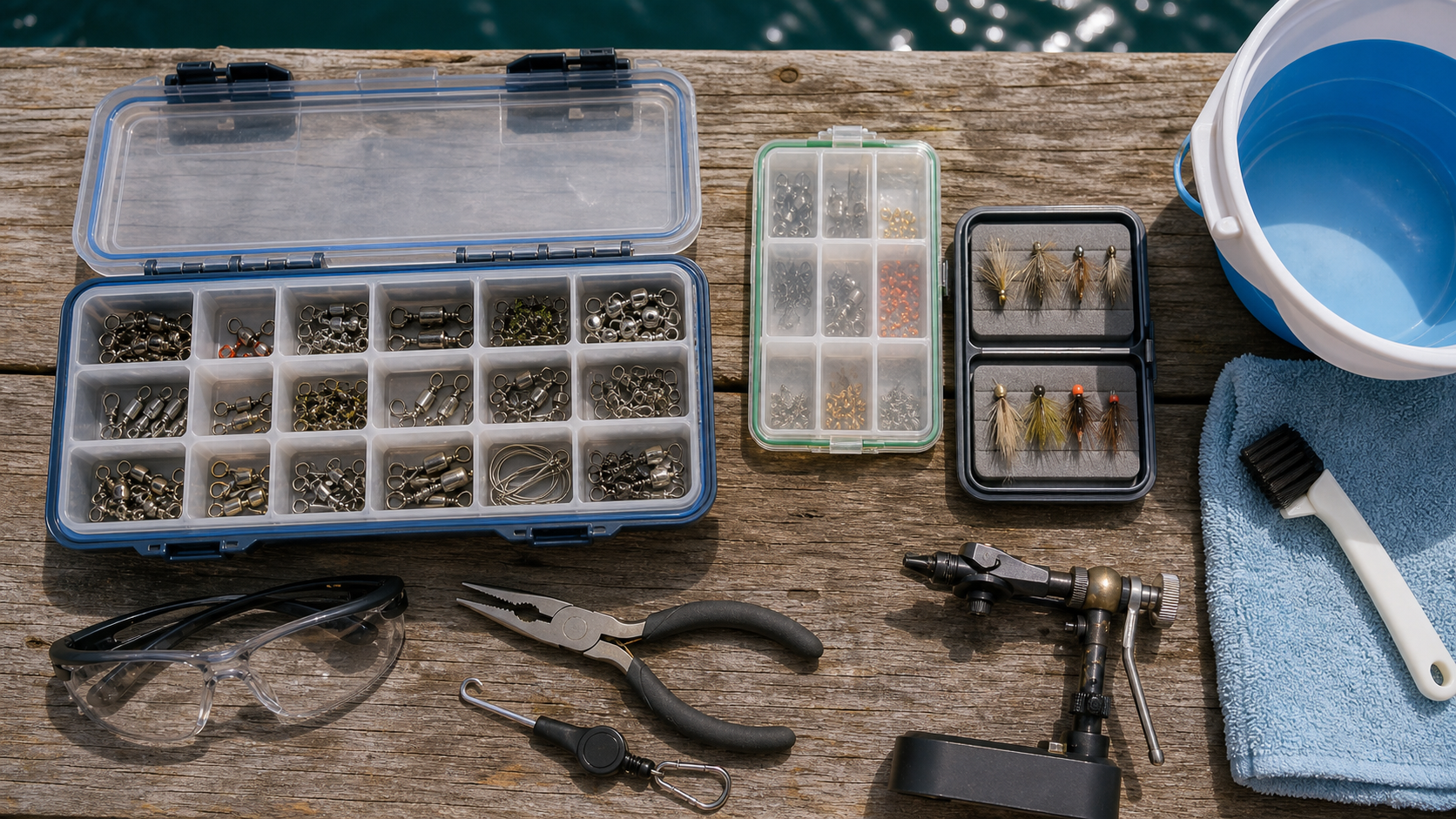
The practical answer: organize summer tackle by task, contain every hook point, separate wet gear from dry storage, and clean, drain and dry equipment before moving between waterways. USA Fish Bait’s verified catalog includes tackle boxes, swivels, fly boxes and a tying vise—not live bait. No organizer or terminal-tackle item guarantees a catch or a particular species.
Fishing seasons, hook rules, bait restrictions, invasive-species requirements, licences and transport rules vary. Check the current regulations for the exact state, province, waterbody and species before every trip.
A five-zone tackle system
| Zone | Contents | Main check |
|---|---|---|
| Terminal tackle | Swivels and connectors | Size, corrosion and closed compartments |
| Fly storage | Dry artificial flies | Hook points secured and box ventilated as designed |
| Trip organizer | Frequently used tackle | One labelled location for each item |
| Tool station | Pliers and hook-removal tool | Reachable without searching near loose hooks |
| Cleaning zone | Brush, towel and rinse container | Clean, drain and dry away from the launch |
1. Start with an empty-box audit
Open every compartment at home on a clear work surface. Remove old line, packaging, damaged connectors, rusted items and unidentified materials. Dispose of line and sharp tackle through an appropriate local program; never leave them at a shoreline or launch.
Assign categories before refilling. The 14-Compartment Fishing Tackle Box provides fixed sorting spaces, while the Double Sided Fishing Tackle Box offers two storage faces. Verify current dimensions, closure design and compartment configuration on each live listing. A closed box should not be assumed waterproof, airtight or flotation-rated unless documented.
2. Store swivels by verified size and type
The Sea Bean Fishing Swivels are an active terminal-tackle listing. Keep different sizes or types in separate compartments and retain any manufacturer information. Do not select a swivel by appearance alone; the complete rig, line, target conditions and current product specifications matter.
Inspect for bent eyes, incomplete closures, rough edges, corrosion or deformation. Retire questionable hardware rather than mixing it back with serviceable items. This guide does not provide load ratings, rigging instructions or species guarantees.
3. Make every hook point visible or contained
Handle one hooked lure or fly at a time. Wear eye protection during tying, clipping or tensioned-line work. Use long-nose pliers or an appropriate hook-removal tool, keep fingers outside the hook path, and never pull a snag toward your face or another person.
The Slim Fly Fishing Box can separate artificial flies from loose terminal tackle. Seat each fly in the intended holder rather than tossing it into a compartment where points overlap. Close the box before moving it. Keep it away from children and pets.
If a hook penetrates skin or the eye, do not rely on an improvised online technique. The Mayo Clinic advises seeking prompt medical help for deeply embedded hooks, hooks near the eye, joints, tendons or nerves, and other serious injuries. Call emergency services for severe bleeding or eye injuries.
4. Set a stable fly-tying station
The Rotary Fly Tying Vise belongs on a stable, well-lit work surface. Confirm how the current model mounts and follow its instructions. Secure the hook before applying thread tension, point it away from your face and keep materials and tools outside the rotating path.
Use safety glasses and control clipping debris. Store scissors, bodkins and hooks immediately after the session. A vise is not a general clamping tool unless the manufacturer says so, and its title does not establish compatibility with every hook size.
5. Pack a reachable tool layer
Pliers, line cutters and a hook-removal tool should have defined locations that can be reached without digging through loose tackle. Add a small first-aid kit, sun protection and drinking water separately from sharp gear. On a boat, secure boxes so wakes and turns cannot launch them across the deck.
The U.S. Coast Guard recommends wearing an appropriate life jacket. Select a U.S. Coast Guard-approved device suitable for the activity and wearer and follow applicable carriage rules. A tackle checklist never replaces boating training, weather judgment or required safety equipment.
6. Use Clean, Drain, Dry between waters
Federal and state invasive-species programs commonly direct boaters and anglers to clean visible plants, animals and mud; drain water from equipment; and dry items before entering another waterbody. Exact steps, decontamination requirements and drain-plug rules differ by jurisdiction.
- Before leaving the access, inspect boats, waders, nets, anchors, lines, boxes and tools.
- Remove visible plants, animals, mud and debris and place them in designated disposal.
- Drain all water where legal and required—never move water between waterways.
- Use the local agency’s required hot-water, drying or decontamination method.
- Keep cleaned dry tackle separate from still-wet equipment.
The U.S. Fish and Wildlife Service promotes Clean, Drain, Dry practices, while state agencies may impose more specific rules. Always follow the stricter current local direction.
7. Dry gear before closing storage
After permitted cleaning, open empty boxes in a secure ventilated place away from children and pets. Dry compartments and metal parts fully before repacking. Do not trap wet flies, line, tools or swivels in sealed storage. Inspect foam or magnetic retention areas according to the box instructions.
For saltwater use, follow the manufacturer’s freshwater-rinse and care directions for each component. Do not combine cleaners or apply oils to tackle that may contact waterways unless explicitly suitable. Dispose of cleaning water and debris as local guidance requires.
8. Build a trip-specific loadout
Carry only the tackle permitted and useful for the planned waterbody. Review regulations before packing, not at the ramp. Confirm licences, seasons, closures, legal methods, hook type and number, possession limits, aquatic-invasive-species rules and any bait restrictions on the responsible agency’s official site.
A compact “today box” reduces searching and loose-item exposure. Keep reserves at home. Photograph the organized layout so every item has a return position, but do not treat yesterday’s regulations as current.
Ten-minute pre-launch checklist
- Open the official regulations for the exact waterbody and date.
- Confirm licences and required safety equipment.
- Inspect every box latch and contain all hook points.
- Remove corroded, bent or unidentified terminal tackle.
- Put pliers and the hook-removal tool in reachable locations.
- Secure boxes and tools for transport.
- Keep clean, dry gear separate from wet equipment.
- At departure, Clean, Drain and Dry as the local agency directs.
- Dispose of line, hooks and debris responsibly.
- Never move fish, bait, water, plants or animals where prohibited.
Frequently asked questions
Does a tackle-box system improve catch rates?
It can make equipment easier to find and handle, but it cannot guarantee bait effectiveness, catches or species.
Can I move wet tackle to another lake?
Do not assume so. Follow current Clean, Drain, Dry and decontamination rules for both locations before moving equipment.
Is a closed tackle box waterproof?
Only if the exact product documentation establishes that rating and you follow its use limits.
What should I do with damaged hooks and fishing line?
Contain sharp points and use a local disposal or recycling program. Never discard them outdoors or at the launch.
Where do I check fishing rules?
Use the official state, provincial, tribal or federal agency responsible for that exact waterbody. Rules can change during a season.
Bottom line
Summer tackle organization is a safety and stewardship practice. Separate swivels, contain hooks, stabilize tying tools, secure boxes in transit, dry gear fully, and follow local Clean, Drain, Dry rules. Organized equipment cannot promise fish—but it can support safer handling and responsible movement between waters.